
June 7, 2026
How to Help Your Child Master PSLE Math Word Problems Using the Model Method
How to Guide Your Child at Home
If there is one thing that causes collective anxiety among upper primary parents in Singapore, it is PSLE Math word problems. As students move into Primary 5 and 6, the questions stop being straightforward calculations. Instead, they turn into complex, multi-step puzzles involving ratios, fractions, and percentages.
When stuck, many students try to guess the operation or apply formulas blindly. But the most powerful tool your child has to conquer these questions is something they have been learning since Primary 1: The Singapore Model Method.
When used correctly, drawing a model transforms abstract text into a concrete visual map. Here is how you can help your child move past the struggle and master the model method for high-stakes exams.
Why Students Struggle (And How Models Fix It)
Upper primary word problems are intentionally designed to confuse students who rely on rote memorization. A single problem can quickly overwhelm a child by introducing multiple shifting values across different categories.
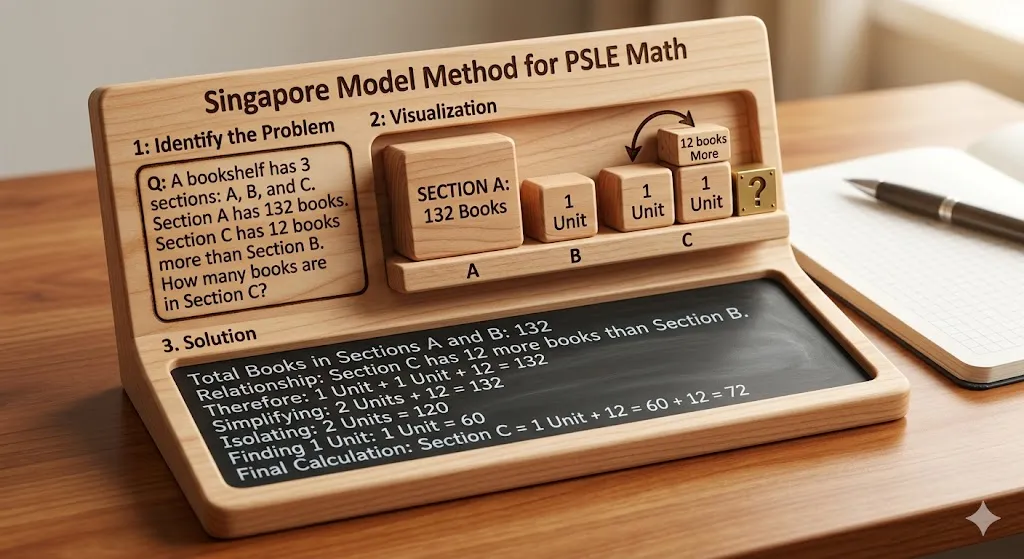
As shown in the pic above, a complex question about a bookshelf with multiple sections (Sections A, B, and C) becomes significantly easier to digest once it is translated into visual blocks. Instead of trying to juggle the numbers mentally, a student can clearly see the concrete relationship between the parts: Section A is a known fixed block of 132 books, Section B represents 1 base "Unit", and Section C is that exact same "Unit" plus an extra block of 12 books.
By laying out the components visually, the bar model perfectly bridges the gap between reading a wall of text and executing the actual arithmetic. It takes away the guesswork and answers the toughest question a student faces: "Where do I even begin?"
3 Core Model Strategies Your Child Must Know
By Primary 5 and 6, basic part-whole models are no longer enough. To score well in Section B of the paper, your child needs to master three specific advanced modeling frameworks.
1. The Comparison Model (For "More Than" / "Less Than")
This is crucial when a problem compares two or more distinct entities.
- The Trap: Students read "12 more" and immediately want to add 12 to the nearest number without understanding the relationship.
- The Model Fix: Draw parallel or stepped bars. If Section C has 12 more books than Section B, the bar for Section C must physically extend past Section B, with the extra segment clearly labeled as 12. This prevents careless calculation errors.
2. The "Before and After" Model (For Change-of-State Heuristics)
These problems involve scenarios where items are given away, bought, or transferred, changing the ratios between items.
- The Framework: Teach your child to draw two separate sets of models: a "Before" state and an "After" state.
- What to Look For: Identify what remained constant. Did individual quantities change while the total stayed the same (internal transfer)? Or did one item stay completely untouched? Identifying the "unchanged variable" on the model unlocks the entire problem.
3. The Remainder Model (The "Drop-Down" Method)
When a question reads: "John spent 1/3 of his money on a book and 2/5 of the remainder on a pen...", a standard bar model falls apart.
- The Strategy: Use the drop-down method. Draw a main bar for the total. Cut off the first fraction (the book). Then, take the leftover segment, "drop it down" to create a brand new, clean bar underneath, and divide that new bar into fifths for the pen. This keeps the fractions visually distinct.
How to Guide Your Child at Home: A Parent’s Action Plan
If your child is staring blankly at a page, avoid the temptation to show them how you would solve it algebraically. Instead, coach them through the modeling process with these three steps:
- Step 1: Unpack the Data Sentence by Sentence. Don't let them read the whole paragraph at once. Read the first clue. Ask: "Who or what are we talking about? Let's draw a bar or label a block for that first."
- Step 2: Label Everything Immediately. An unlabeled model is useless. Every time a bar is drawn, write down the names, the known values, and place a question mark (?) over the exact piece of information the question is asking them to find.
- Step 3: Hunt for the "1 Unit" Value. The golden rule of the model method is finding out what a single block (1 unit) represents. Once your child realizes how to isolate the units (e.g., seeing that 2 units = 120), finding 1 unit (60) makes solving the final calculation a breeze.
The Teacher's Touch Approach: While drawing models is incredibly effective, it can feel tedious to students if they aren't taught how to draw efficiently. At Teacher's Touch, our ex-MOE tutors teach students how to identify the correct heuristic pattern before their pencil hits the paper, saving precious minutes during the actual PSLE examination.